One of the most common teenage problems is losing weight. Be it a skinny girl who thinks she’s fat when in reality she’s not, or a guy who really wants to show off his six packs to his friends, there is one simple way to lose weight. Track your calories and frequently exercise, of course! A calorie is the unit for energy for which the food you consume will be converted into after digestion. These calories will be burnt off during exercise after being converted from glucose or stored in the muscle tissues as glycogen or fats.
The idea of calorie tracking to manipulate your weight is indeed very simple. If you want to lose weight, simply have a daily calorie deficit. For guys who want to gain mass, simply do the opposite which is a daily calorie surplus. Before doing anything however, you must first determine your maintenance calorie amount. This can be done by either finding some spreadsheet formulas online or trying out different daily calorie amounts every 2-3 weeks to find out which amount causes the least fluctuation in your weight. After that, you will be able to manipulate your weight with ease simply by adjusting your calorie intake, either adding or subtracting 100-200 calories each week. Caution must be taken when going on an excessive calorie surplus or deficit as this can lead to either anorexia or obesity.
This is where I point out that calorie tracking must come hand in hand with counting your macronutrients and micronutrients. The 3 main macronutrients are protein, carbohydrates and fats. Micronutrients such as vitamins and minerals are only needed in small amounts compared to macronutrients. However, micronutrients are essential for good health and micronutrient deficiencies can cause serious health problems. This combination of calorie counting and micro/macronutrient tracking is also known as flexible dieting.
Most of you fitness freaks may not know about this flexible dieting. This is because there is a misconception in the fitness world that in order to be fit or lose weight, one must abide by the rules of clean eating. Clean eating is what most of you have either heard or read about over the years from fitness blogs to health magazines. The term clean eating refers to high nutrient dense food with the least possible amount of preservatives, colouring and additives. Examples of such foods are sweet potatoes, brown rice, oats, broccoli and many other veggies, chicken breast, turkey breast, egg whites and etc. Processed foods such as potato chips and ice cream are considered off limits because these foods have inefficient nutritional value. The difference between flexible dieting and clean eating is that as long as you keep your macros in check, having a large fast food meal isn’t as much of a sin to flexible dieting as it is to clean eating. In reality, clean eating has been proven to cause weight gain instead of weight loss! This is because flexible dieting involves the tracking of what you eat everyday and how much calories each meal contains while clean eating is just an assumption that eating healthy foods no matter how much will result in weight loss.
Therefore, if you want to lose weight, calorie tracking and making sure you have your macro/micronutrients in check is the way to go.
By Chiang Kah Chun
Expanding Your Repertoire of Learning and Studying Strategies – NOW is the time!
Coming from an education system that served Canadian students and graded them using 100% internal assessment, to Taylor’s College where all three programmes have a significant component of external assessment (100% for CAL, 70% for IB, 30% for SAM), has been very interesting for me. CAL, I have come to learn, is a system that has been in existence for over 150 years, and is highly respected all over the world. Getting As on a CAL diploma serves successful students with a ‘ticket’ to good universities worldwide. I have observed and talked to several TCSH students and teachers about your methods of preparing to achieve these As, and I notice an absolute dedication to a) going over past-year exam questions, often multiple times, and b) studying for long hours alone.
TC has a long-standing and well-earned reputation for helping students achieve As, so I am not about to suggest that you change a formula that so clearly works for so many. However, I would love to encourage you to expand your repertoire of learning strategies, and to recognize that your 1 to 2 years in Pre-U is also about learning as much as possible, not just about achieving your ticket.
Check out these photographs of a person’s brain when they are thinking quietly to themselves (left photo) and when they are discussing a concept with others (right photo):

Brain research and the connection to learning is a fairly young branch of Science, an area to which some of you will likely contribute in the future. Photos such as these, and indeed experimentation on live brains, only became possible about 15 years ago with the development of a technique called PET (positron emission therapy). If discussion with others utilizes so much more of your brain than working alone, wouldn’t it make a lot of sense to include this technique when you are processing new information, and also when you are studying to prepare for an exam? It has also been shown that the memory storage differs from these two ways of using the brain. The brain that has been ‘exercised’ in the way shown on the right will develop more neural pathways related to the information that was being learned at the time, making it more easily retrievable and retrievable for a longer period.
What do you think? I would hope that this might encourage some of you to try testing your flash cards on one another, sharing answers to a past-year exam question and giving each other helpful suggestions, or creating study groups to prepare for your next big assessment. Study groups can be unstructured, or can be structured in a variety of interesting ways, for example each member could prepare a session for the group on a topic that they understand well. The session might include a brief tutorial, and then a question-and-answer session, and some collaborative practice to follow up.The CAL trial exams coming up would be a low-risk opportunity to “experiment” and see if expanding your repertoire to include some collaboration or discussion with others helps you learn more effectively and retain your knowledge for longer. Remember that, whenever you try something new, it feels awkward at first, but if it is something as important as this, it is worth persevering and giving your experiment the serious effort it deserves. I would love to hear from some of you who attempt to expand your repertoire about how it feels, and particularly about the effect it has on your exam results. Good luck and happy learning!
My first day of school,
I felt like a fool,
Who knew that it was this cool,
Tomorrow I shall wear some wool.
Why is it so hard to swallow?
And why do I feel so mellow?
I wished someone would say hello,
So that I won’t feel this hollow.
Maybe I should run a mile,
Or really try to smile,
Why does everyone look so vile?
Am I really that hostile?
Oh no, here comes a hand shake,
I fear my numb fingers may break,
Why is this place so sick,
They should really turn it up for our sake.
Written by Rachel Quek
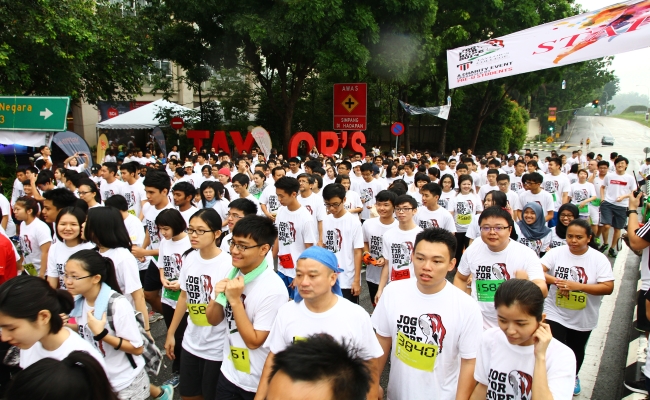
Running a “Personal Best” in the 2013 Jog For Hope – a SMART Goal
I have done a lot of running, and coached a lot of runners, in my life. I first joined a track club when I was 13 years old, and have run cross-country, track (800 m was my specialty), and the road race circuit ever since, except for a short break in my early twenties when I got chubby and somewhat unfit. (THAT may have to be the topic of another column – beware the “freshman 15”, 15 pounds (7 kg) being the average amount of weight that students gain in their first year at university.) My road racing included 5Ks, 10Ks, half-marathons (21K) and marathons (42K), as I discovered that endurance was my strength and lack of speed definitely my unconquerable weakness. I coached high school cross-country teams every year of my 33-year teaching career in Canada, and enjoyed sharing the love of running with thousands of young people on those teams
Mr. Josh (IB Chemistry teacher), Chin Kar Yern (IB Senior) and I are going to start a running club for TCSH in early July, with the main goal being preparation for the Jog for Hope run on September 15th. We will pick three times per week when the club members can meet to run together – one at 4:30 pm, one at 6:30 pm and one at 7:00 am. We will create a custom training plan for everyone who joins, and hope to have a full range of members’ experience – from never having run at all and wanting to get ready for the 3K Fun Run, to experienced runners looking for motivation and support in the months leading up to Jog For Hope so they can be competitive in the 6.5K or the 10K. The training plans will suggest 4 – 6 training runs per week, so many of them will be done on your own schedule, not on the official club running days. We will hope that every club member can attend at least one of the club runs each week. Staff members and family members are welcome too!
One of the things I always loved about running is that it is an activity where goal-setting and following a plan actually make an immediate, noticeable difference. Every time you run a distance, it feels a little easier than the time before, AND you go a little faster. Regular training, especially when you first take up running, will cause you to improve steadily and continuously, truly almost every time you go out. And this happens for everyone, not just for super athletes or natural runners. It is very satisfying, so satisfying that I really want to share it with some of you! Because it is such a powerful, measurable example of the success created by goal-setting and planning, I am sure that the lessons learned by this running experience could easily be transferred to your academic studies and your professional goals as well. Now would be a really good time to revisit your goals for the upcoming semester, and to create an action plan to achieve them. What are you going to do more often next semester? What are you going to do better next semester? You have to repeat something 21 consecutive times in order for it to become a new habit…
Another good reason for TCSH students (and staff members) to run is stated by Denise Schipani, a writer for the “Runner’s World” website: “You're smart to run and smarter because you do—hitting the pavement helps grow new brain cells, makes you a better learner, and boosts memory”. See her whole article, with links, here.
I hope that many of you join the new TCSH Running Club. It will start unofficially the week of July 1st, and officially the week of July 15th, after the ECA Recruitment Drive. Here’s to a new, smarter, fitter TCSH community!
P.S: TCSH students, make sure you have "liked" our official Facebook page "Taylor's College Sri Hartamas - TCSH" if you want to keep up with the college news, events and notices.
At first sight you will behold her complexity,
Second, third appraisals shall reveal her beauty;
Listen patiently; the craftsman wants to be heard,
Recite aloud for her glory to be unearthed.
Embalmed in letters right on top -
Signage of an ancient bookshop;
Therein lies the key, clue and map,
Perfected with the gift of gab.
Her figure of speech captivates your heart,
Similes and imageries a form of art;
Her literary maneuvers will never harm,
Metaphors and symbolisms are merely charms.
Scrutinise her structure, her exquisite form,
Styled with rhyme or disordered like a storm;
Feel her heartbeat; It’s pulsing through her veins,
Punctuation, enjambment; splendor attained.
Consider her inward thoughts, breath of a sage,
Burdens and emotions that seem to rage;
Through her tone, her true colours revealed,
Intents, motives never are concealed.
Written by June Lee Pui Yin
One of my favourite quotes is by an American cultural anthropologist named Margaret Mead. She said “Never doubt that a small group of thoughtful, committed citizens can change the world; indeed, it's the only thing that ever has.” I think our recent recycling initiative at TCSH is a great example of this principle in action.
There is so much garbage in the world that a couple of countries have proposed taking a corner of one of their national parks and turning it into a garbage dump, a landfill. How sad that we seem to focusing harder on where to put our garbage than on reducing it down to a manageable amount. At TCSH, we have reduced the number of garbage bags we send to the landfill from an average of 45 bags per week to 36 bags for each of the last two weeks since we have been paying attention to our recycling. If we keep that up we will put out about 450 fewer bags of garbage than we did last year! We also recycled several months’ worth of paper being kept by the exam unit that would normally have been sent to the landfill. If a small community like TCSH can reduce our garbage by 500 bags annually just with a TINY change in our habits, can you just imagine how drastically the world’s waste management could change with some dedication to this cause?
There are different categories of environmental issues. The three “biggies” are Waste Management (reduction of garbage), Energy Conservation and Environmental Stewardship. I have given a suggestion for each of the first two for something I think TCSH students and staff members are ready to try.
1. Waste Management:
Reuse your water bottle. Avoid buying bottled water. In fact, reuse everything at least once, especially plastics.
2. Energy Conservation
Try car pooling or walking or biking or something that reduces the number of car rides you take in a week. (I would love to start an on-line car pooling ‘matchup’ for TCSH. If anyone has an idea on how to get this started, come and see me.)
Do you know what your carbon footprint is? It is the number of tons of carbon emissions that your particular lifestyle creates in the world. There is a website that helps you determine your carbon footprint, very roughly and quickly, and also tells you how many trees it takes to absorb the amount of carbon you are producing. I don’t even own a car and I just calculated my annual carbon emissions as 28.59 tons, which would take 24 trees to offset. The website is here. Calculate your carbon footprint …
And if you do, enter your name , the number of tons of carbon, and the number of trees required to offset it into this spreadsheet I created at Google Drive to allow us to collect TCSH data.
 What does the future hold? Here is one artist’s version of what Australia will look like in 2050 (Adrian.salamandre/Flickr). None of us can really answer this question but it is ostrich-like to believe that the Millenials/Linkster generation can continue to ignore environmental issues and live the good life for decades to come. I invite you now to try my two suggestions above, AND to show that you are part of our “small group of thoughtful, committed citizens” by supporting the transition of TCSH from a college that recycled almost nothing to one that recycles more than it discards. Your ideas for how to help make this more and more successful over the next few days, weeks and months would be greatly appreciated!
By Lauren Wilson
Home has always been a physical place to me. The term 'home' in my mind is contained within the walls of my childhood home. And the very idea of having to live somewhere else - and having to call that place home seems like some form of betrayal. Thinking about it always left me feeling uneasy.
I, for one, did not exactly have a smooth transition into what would be the next phase of my life. I visited my apartment unit one week before college was to officially begin. Everything was (surprisingly) in good condition, the whole place tastefully decorated - except for the fact that there was this one locked room from which eerie, beeping sounds came from. And guess who got the room beside this mysterious space? That's right, yours truly. Wild speculations by my younger sister and a 9 year old cousin did not help. With cheeky grins plastered on their cherubic faces, they insisted that there had to be SOMETHING sinister inside that had to be locked away from prying eyes. They a little more than subtly suggested that there could be a high probability of discovering a dead body inside. Scenes from Mr. Monk (TV series about a detective) and Roald Dahl's disconcerting account of landladies flashed through my mind. Involuntarily, my hair stood on end.
With every fiber of my being, I wanted to disprove what those little ones had said. Instead, believe them I did - all gazillion atoms of a supposedly rational, mature and composed 18 year old. Back in Penang, I was terribly disturbed and could do nothing much other than obsessively Googling the name of the apartment, trying to stumble upon evidence of its stringent safety measures. I was desperate for anything. Anything that could calm my rattled nerves. Instead, all I came up with was more unnecessary information about how a middle-aged lady apparently committed suicide in one of the units.
Things certainly did not seem any better when of all things, I left my whole bunch of keys AND the access card in Penang. For more than a week, I could only pass through the security doors and get into my unit through the good graces of the guards, residents who were complete strangers to me, or my lovely housemates. Everyone found it ludicrous that I could forget the most glaringly obvious thing - my keys. To be honest, I was madly annoyed with myself - almost disbelieving that I could remember to bring bobby pins for my hair but and little knick-knacks for my room but could so conveniently forget to bring the one thing I needed most. This was how I learnt lesson one: Always have your keys with you. In fact, never leave the unit until all these items have been checked off your mental checklist.
Handphone? Check. Wallet? Check. Keys? Check. You're good to go!
One of the biggest challenges about leaving home is the fact that you are entirely on your own. This comes with certain degrees of freedom - but what it really encapsulates is having to settle all your meals and laundry yourself, somehow still finding time to complete all your assignments and be on top of your studies. Having been pampered all my life by Mom's cooking, this was a change that I had a hard time getting accustomed to. The last thing I wanted was to fall sick, and getting enough nutrients was something that I worried about constantly. This explains why the first few days found me making a meticulous inventory of the food I had, followed by attempts to piece the food together to make a meal that was as balanced that it could get. On that note, grocery shopping alone for the first time was an entirely awkward event. I read food labels and handled fruits in an attempt to look adept, when in actual fact, I had no idea what on earth I was looking for. But as they say, there is always a first time for everything. And the best way to become adept is to experiment until you get it. This season of my life was one of many firsts: I learnt how to cut a dragon fruit by way of trial and error. I learnt that canned tuna does not go well with toast bread in the least - and that it is possible to withdraw money from an ATM that is not specific to the bank you are using.
It never ceases to amaze me - the range of lessons I have learnt and experiences I have gained in a mere 3 weeks away from home. There was this one time when I had stayed up doing homework. Suddenly, my peace was broken by a pounding in the kitchen. I jumped up with a start, armed with my trusty craft scissors and headed stealthily for the kitchen, only to find that the noise came from our slightly besotted washing machine which was tumble drying clothes. Then there was the night I attempted to get laundry done past midnight, and ended up clipping my finger in the hinges of the laundry machine door, suffering a temporary blackout. I have had weird conversations with my housemates, the strangest one concerning the fate of a certain money plant in a blue basin that had been bequeathed to us by the landlady: to keep or to throw away?
But there's the bright side too. Like how I have learnt the advantages of living at a substantial height above the ground. For one, you get to spy on your other friends leaving for college in the mornings, which also entails being able to scare your housemate by popping out at the door like a jack-in-the-box the moment she returns, having been able to predict the exact moment she would be at the door.
More importantly perhaps, living in an apartment for the first time has redefined community for me. There is something very special, a certain warmth that comes with the security in knowing that there is life all around you, that we are only separated by the spaces between the cemented walls. I used to dislike the idea of living in an apartment as it seemed to me like being placed in a claustrophobic box. But put those boxes side by side, and you get community.
As I write, orange lights glow from within closed glass doors. If you look into each unit, you are allowed a glimpse into someone else's life. A ceiling fan whirring. An exercise machine. I remember the comfort these lights gave me on my first night alone in this foreign place. I had felt utterly despondent and had opened the windows to see those lights, (evidence that life was still prevalent) and to hear mirthful laughter rising up to my window, crystal clear in the still of the night.
Today I heard myself calling this unit, this foreign box home. The funny thing was, it flowed out of me in a manner that was completely natural, as if the term home had somehow fused with this place and the people in it; they had melded together as one. It occurred to me that perhaps, home is not a physical place. Rather, home is the people, the experiences and more importantly, what you make of it.
BY ELEASHA CHEW
I am thrilled to be part of the launch of the new-and-improved Online Beacon! Sincere congratulations to the 2013 Editorial Board for your teamwork and your collaborative journalism skills that contributed so fully to the quality and timeliness of this launch. Keep up the good work! I look forward to submitting monthly column about activities and educational issues at TCSH and in the world, and happy that my first column is part of the great new 2013 version of the Online Beacon.
I am finding it hard to believe that I have been at TCSH less than three months. It has already altered my life in so many ways, and the students and staff members I have met have been so open and welcoming and generous, that it is completely“under my skin” … I have enjoyed observing the strong work ethic and commitment that so many students bring to their college studies. I have enjoyed observing how dedicated the teaching staff is, to improving their ability to create passionate and lifelong learners among their students, as well as guiding them in the achievement of their academic goals. I loved getting to know more than 100 of our student leaders, and some of our dedicated Admin staff, at the Dusun Eco Leadership Camp! I was blown away by the small but amazing committee that put together the first ever Incitement Youth event in Malaysia, at TCSH on February 28th, and whose members continue to be invested in the growth of this positive movement. I love it when students drop in to my office to talk about anything, even if it’s to bring me a challenging problem. I love saying good morning at the front door. I love having so many students and staff members as my new FB friends (and real friends). I look forward to traveling to Cambodia with the IB students, to being a participant in the staff yoga class, and to being a staff adviser for both the Dance team and the Jog For Hope committee and a member of the Music club, and seeing what adventures those roles bring to me.
I have lots of other ideas for things I would like to do at TCSH with students.
- - I would like to start a“homework club” that meets once a week for an hour or two after school to work on homework together. I would help attendees with as many math and science questions as I could, and help with brainstorming ideas, wording of answers, or editing of essays for any and all subjects.
- - I would like to start an“Inspirational Videos” club that shows a half-hour’s worth of video clips once a week.
- - I would like to work out the details of a recycling plan for TCSH that would have all of us reducing the amount of garbage we produce by re-using and recycling as much as possible.
- - I want to help some of the CAL and SAM students benefit from the good ideas we have received as the result of being an IB World School – maybe by providing the opportunity for all of our students to monitor their Creativity – Action – Service hours, and /or gather evidence in a meaningful way of aspects of the learner profile that they demonstrate.
I would like to share with you the following words of Judy Ng, a TC graduate in 1971. I find it surprising how relevant these words remain, over 40 years later! How can we, together, put some things in place to ensure that TCSH continues to push the boundaries and provide positive and rewarding learning adventures and prospects for our students well into the future? I look forward to sharing ideas with you through this column and in the halls of TCSH. Let me know if you like any of my ideas for the future, and/or if you would like to share a few of your own … Thank you for the privilege of being your principal.
“Being a Taylor’s student is, in itself, a new adventure to most of us. The new teaching aids and methods, the new independence we experience, the fact that this is one of the very few coeducational institutions where the minority females are striving to be equal to their male counterparts in all fields, above all, the prospects of going abroad to familiarise with a totally different way of life,all these are indeed both frightening and exciting. Certainly we are not going abroad only to gain academic knowledge. We are some of the thousands of ambassadors of our country. It is an undeniable fact that the surge of Asian students who are going abroad to study is one of the most remarkable features of our age. It is thus vital to bear in mind that the image we make or un-make of ourselves and of our country is the outcome of our personal conduct and attitude, whether we are rightly or wrongly proud of our heritage and traditions.” (Judy Ng in the College Magazine 1971, quoted in Ted Miles’ Only Yesterday, Taylor’s College The First 25 Years)
 |
|
Ms.Lauren became the principal of Taylor’s College Sri Hartamas in January 2013.She writes a weekly column called “Principal’s Corner” which is published on the student portal and on a TCSH Facebook page every Monday morning. She will also be writing this monthly column for the Beacon Online.
BY LAUREN WILSON
Chapter
1: The End of the Insurrection
0859
hours, 25 June 2524
Venezia,
capital world of the Insurrection
Staff Sergeant Jason Cook stared across the barren land,
looking for some hint that the peace talk was about to take place. As sniper of
his ODST team, Kilo One, he was tasked with spotting the dropships that would
now be making their way to the meeting spot, carrying the highest ranking officers
from both warring militaries on the planet. The meeting spot was located in the
middle of the no man's land, a dying land which stretched almost two thousand
kilometres from east to west. There was only one mountain range in no man's
land, and Kilo One had already set themselves up there to provide overwatch on
the meeting.
Imagine that the world is an
enormous dark room and the people of the world are candles, shining with a
light known as hope. A person without hope is like a candle without a flame.
War, cruelty and suffering can be compared to a chilly wind that extinguishes a
candle’s light. When the wind comes, some candles flicker and then shine all
the brighter; some candles splutter and burn no more. It is not that they cease
to exist… They simply have lost the will to live. All they need is another
candle to reignite them.
I paused for a moment, swiping my sweaty hair from my eyes and taking a quick glance
around before continuing the steep uphill climb. I was leading our sad band of four, with my
brother, Wyatt bringing in the rear. We were almost at the peak; of what, I wasn’t sure. All I
knew was that everything was bigger and brighter here, the colours more vivid, the sounds
sharper, more piercing. And there it was - a dead end, and yet it wasn’t. I came to a halt and
stood there, gaping.
Dear Diary,
Today I stand here, in mourn of my beloved, who recently braved the Algorithm Woods in an eternal battle against the evil forces of ignorance, and never returned. May his soul rest in peace.
Dear Diary,
What is the actual definition of a break anyway?
(a) A beautifully planned week where we can cut some slack after all the hard work we’ve been doing?
(b) The week where we’re assigned to increasing amounts of homework piling up to seek competition with Everest?
Dear Diary,
I think I may have developed a tiny, little feeling (otherwise known as a crush) for someone in my class. She's beautiful, she's smart, she's just... Special. And even though she, like the rest of the students, never fails to give a sarcastic (sometimes hurtful, but in a good way) remark about my so-called "nerdish" ways, I have a feeling that deep, deep inside of her, she is actually attracted to me. I mean come on, after all, nerd is the new black. I bet that subconsciously, she believes that I'm a sexy beast...
Dear Diary,
I have no idea why I'm being classified in the category of “nerds” by my classmates. According to my favourite website Wikipedia:
Dear Diary,
The exam results are in. I scored not too bad actually. Considering that I didn’t even put any effort in for mid-sem, 4Bs and a C, it’s acceptable, to me at least. For my parents however, that’s another story. But who gives a damn anyway? It’s just mid-term.