
Showing posts with label school. Show all posts

In the past few months, the act of recycling has gradually been taking on the spotlight. Just finished a bottle of water? RECYCLE. Just finished a packet of Milo? RECYCLE. Just received a nightmarish score on your Maths test? RECYCLE (okay maybe not until after your exam). And with the introduction of a mini recycling bin in every classroom, recycling is now easier than ever in TCSH. Despite this new ease, however, many people still seem to be demonstrating a lack of understanding and an overall lack of care for recycling. Did you know that by disposing of your recyclables into the appropriate bin, you could be building roofs, providing prosthetic limbs, jackets and all while saving crazy amounts of energy?


Everybody knows that recycling is good for you. It is good for the Earth, which will be good for us so why don’t we do it? It really is not that hard to walk a few more steps and throw your plastic bottle into the recycling bin instead of the normal bin and it really is not that hard to choose the right bin. The amount of waste we produce can shock you. Collectively, Americans use approximately 2,500,000 plastic bottles every hour. The average American uses seven trees a year in paper, wood, and other products made from trees. This amounts to about 2,000,000,000 trees per year. And these are just statistics for America, a single country. Can you imagine this for the whole world?
So what really happens to those plastic containers, aluminium cans, paper and tetrapaks you throw into the recycling bin?
Let us start with the plastics. The majority of the right plastic that gets recycled in TCSH consists of plastic bottles. The majority of the wrong plastic consists of plastic bags and plastic wrappers (yes, those Tim Tam wrappers and Mamee Monster packets are sadly not recyclable at TCSH). Also, please note that plastic lids on coffee cups are actually recyclable plastics - if you look closely at the lids, they actually have a recycling label on them.
Once delivered to the recycling centre, plastics are sorted and then crushed together to form huge cubes. At a plastic processing plant, these cubes are broken down and shredded, cleaned and distributed to manufactures. These manufactures then melt this plastic to be made into different products such as toys, stationery, t-shirts or simply different forms of plastic again and making plastic out of recycled resources uses about two-thirds less energy than making new plastic.


Next up, in the same bin as the plastics, we have the aluminium cans. The pop tabs from aluminium cans can be used to make prosthetic limbs and if you haven’t noticed, there’s a little carton thing that’s attached to a poster around TCSH for people to drop off their pop tabs to go into making prosthetic limbs. The pop tabs are combined with steel to make these limbs for the needy. Surprising as it may be, such a small effort can have a dramatic effect on such a huge industry. Using recycled pop tabs helps reduce the cost of producing prosthetic limbs by as much as 90%.

Aluminium cans are 100% recyclable and are often transformed back into new cans. Making new cans takes 95% less energy to produce than if one were to make a whole new can from scratch. What happens to the aluminium cans exactly after being collected from the recycling bin is similar to plastics – they are formed into cubes, shredded, cleaned, and rolled into thin sheets to be sold to manufacturing companies to be made into cans again.


Onto the next bin, we have paper! Once again, just like plastics, the paper is sorted at the recycling plant. Then, water is added to the paper to create a pulp which is screened to remove glue, staples and such. Like aluminium, paper is often transformed into a similar version of itself again. It takes only a week to recycle newspaper and magazines into fresh newsprint to be printed on again. Cardboard is recycled into other cardboard-packaging products.


Moving on, we have what might be the easiest recyclable item ever - tetrapaks. There is so little room to go wrong with tetrapaks. All recyclable tetrapaks have a label on them and all you have to do is remove the straw from your carton once you’re done and ready to recycle it. (Flattening is also appreciated so they take up less room.) Tetrapaks, like aluminium cans are 100% recyclable - 75% paper fibre and 25% plastic or aluminium. So after being collected by the recycling center, the tetrapaks will be mixed with water in a gigantic blender, kind of like the pulping process with paper. Here, we will obtain a separated mixture - one with paper fibre and one with a polymer-aluminium mix. The paper fibre can be made into tissue, office paper and egg cartons while the poly-al mix can be made into roofing tiles. All these products are made with drying and heating processes.


Side note! You should really try your best to clean all your items before disposing of it in the recycling bin. Grease and food stains on plastics and papers can contaminate the recycling process and cause it to be un-recyclable in the end.
And of course, all these recyclable items can even be used in DIY projects to make all sorts of quirky items from plant pots to decorative household objects to dresses to furniture. Some whole houses are even made from these recyclable items.


Some people may feel that they do not play an important role in the recycling process, that there is simply too much waste (or rather too many ignorant people) such that no amount of recycling on their part could ever really make a difference, and the end of the world is imminent and inevitable and therefore pointless to fight. However, I believe that every single one of us should take on responsibility as a fellow resident of the Earth and make it our job to do our part in making earth a little more comfortable to live in and a little less closer to destruction. The power of one small person, one small act of recycling can cause a huge difference to a huge earth.


Written by Chin Wye Mun


Q: What makes you want to take up the job as the president of Student Council?
To me, Student Council (SC) is a representation of the student body and is an outlet for which the students can express their concerns and needs. As I am person who enjoys mingling with just about everyone, listening, communicating and helping people are second nature to me. I also aim to make an impact (a positive one hopefully) everywhere I go and TCSH is no different. With a hunger to inspire and a passion for people, I thought I would be a suitable fit for the role.
Q: What is your greatest strength that equips you for this job?
Thus far, I believe my greatest strength is definitely my people skills. Being able to understand the needs and wants of not one, but an entire community seems like a challenge but I feel up to it.
Q: Tell us more about yourself. What are you goals and priorities? 
I assure you I'm a perfectly normal human being - not a workaholic robot 24/7. However, I do have some goals that I would like to achieve on a personal level. One of the current ones is to be SC president (surprise, surprise). A few more years down the road, the goal is simply to be happy. I believe happiness is the greatest measure of success because it takes into account all the physical achievements as well as the emotional ones. I would say my priorities include my family and friends - they play a pivotal role in how I am now and how I will be in the future. Then comes a mishmash of education, food, sleep, sports (in an ever-changing order).
Q: What do you think TCSH needs the most right now?
Personally, I believe TCSH needs a strong and effective communication system. For ECA purposes, we have tons of Whatsapp groups and even more Facebook ones online - all of which is often difficult to keep track of if one is not sitting in front of the phone/computer all the time. For academic purposes, the split usage between various learning platforms such as Edmodo and Moodle may actually cause more confusion that rectifying it. Thus, I believe there is a solution and that it's only a matter of time before a structured system is put in place to ensure the smooth flow of both work and play.


Interview by,
Sim Shin Ying,
Head of Writing Department,
Editorial Board TCSH.

Photography by,
Samantha Yong,
Head of Photography Department,
Editorial Board TCSH.


“Dear Nestle,..”

Sound compelling? Most of us can only dream of being able to send an email directly to a big-shot company like Nestle. But that is not how it is done. Jazz Tan, a speaker at last Wednesday’s (25 March) Youth Jam Workshop in TCSH, and founder of YouthsToday.com, a sponsorship and event matching platform, has had plenty of experience dealing with aspiring young founders who squander their sponsorship prospects by sending a simple mass email. In this case, the email was mistakenly sent to Tan’s company, which rejected their sponsorship plea for obvious reasons.

Tan is 25. She has all the enthusiasm of a 17 year old and a knowledge of advertising comparable to that of most veterans in the field. When she awkwardly adjusts the tall Chatime poster in front of the podium while announcing its sponsorship of her workshop, it is clear that she possesses a self-awareness that all young people can all relate to. Yet, when speaking to the crowd of 16-19 year old college students, she commanded attention like any other experienced CEO. Club presidents, student council members, youth event organizers, we were all there to know her secrets.

We are part of an ever-evolving generation that wants to create our own businesses, drop out of school to create viral apps, organize fundraisers for pertinent issues, and engage our communities in the change that we want to create. However, we still have to play by the adults’ rules. We are still kids who rely on our parents to fund our lunch, or in this case, our school projects.

In regards to this, Tan’s message was simply this, know the rules, play the game. Among her feats of entrepreneurship includes organizing an augmented reality race with 1400 participants at zero cost. None. Nil. Nada.

The key is sponsorship--the main topic of the workshop. Remember that mass email you wanted to send to those 100 companies among which you hoped at least 3 would reply? Don’t do that. Your email should address a specific person in the company who is in charge of the company’s sponsorship deals, or even their CSR director. Another mistake that young founders often make is underestimating the relevance or reach of their event, therefore not presenting a desirable image to potential sponsors. What benefits can you bring to companies? Something as simple as a ‘concept tie-in’, like how your youth conference aligns with Maybank’s company values, would be a viable reason for Maybank to sponsor your event.

“Say, you want to bring 200 people to the moon. Impossible, right? How about if we built a moon here? How much manpower would you need? 10K, 10 people per team and 1000 teams?” This is where the workshop stops itself from being just another soporific leadership workshop that a bunch of adults in administrative jobs decided to impose on college students. It is not about personal development or being a good team player, it is about devising a feasible strategy to do whatever the heck you want. That’s what appeals to young people like me, and that is really what is going to spur innovation from the youth to bring greater social and economic change to our country.

Tan has been running her on-going annual event, Youth Jam for 6 years now. True to its objective of promoting entrepreneurship and social awareness among the youth, the event bridges young leaders with mentors, brands, NGOs and government agencies every year.

Her latest venture includes inviting Mark Zuckerberg, founder of Facebook, to Malaysia to attend the ASEAN Chairmanship program this year. She calls on all youth leaders and companies to submit a total of 100,000 videos addressed to Mr. Zuckerberg. You could be a company, a club president, or an interested individual.

She has already partnered up with 10 ASEAN countries. There lies the most interesting of Tan’s strategies: “We go for the coolest kids in town.” (Speaking of which, I could not help but flip my hair) Besides the logistical challenges, the real impetus behind successful projects is the type of people on your side. Which famous person is supporting you? Which newspapers are talking about you? Which trends are your event relevant to? The coolest kids are not just the ones with the latest phones, the crass friends. They are the class presidents, the popular websites, the CEOs, and the leaders of countries. Even the founder of Chatime has sent a video.

Now doesn’t that make you want to start a kickass project of your own?


Written by 
Chua Zi
Member of Writing Department
TCSH Editorial Board

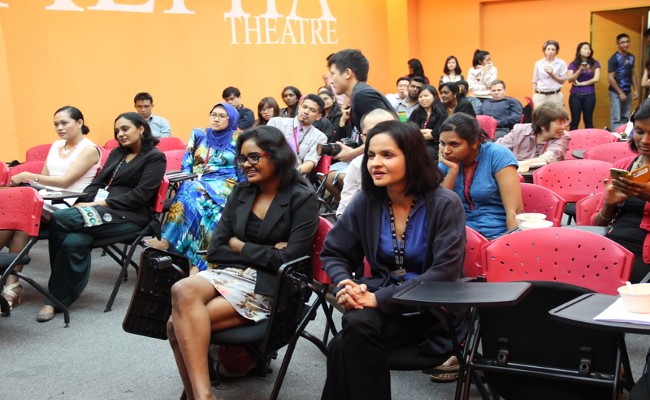
On March 24th 2015, the “I am Where. Are You? Talk” was conducted by 19 year-old Eibhlin

Lim, CEO of her own startup company, Phoenix. Biting the bait of free BurgerLab burgers,

around 70 students gathered in Alpha Theater to listen to the humorous and very relatable teen.

Appearing unassuming and nervous, many of us were still amazed by Eibhlin’s strong personal

journey of self-discovery and persistence.


Misleading us to believe she was talking about a close friend instead, she began by relaying

her story to us. Introducing the character as a 19 year-old girl who took a break from formal

education after finishing her IGCSEs in 2013, the story followed an unexpected path full of both

failures and achievements (two concepts which Eibhlin considers to be interchangeable).

From small falls such as not being able to go to the bookstore on weekends to bigger letdowns

like organising a brainstorming meet-up in Colorado with no attendees, Eibhlin shared with

us how she took her downfalls and turned them into something valuable. Suffering from

her bookstore visit deprivation, Eibhlin decided to apply to write book reviews for The Star

newspaper. At the age of 15 with barely any qualifications besides a blooming love for books,

one probably would have quickly dismissed the idea of even applying to write for the newspaper.

Why on earth would they accept an unqualified 15 year-old student? But they did. I suppose it

goes to show that if you never try you never know.


Following from that, the young introvert succeeded in publishing about 55 articles through

various outlets worldwide, eventually obtaining an offer to write for the highly-acclaimed

Huffington Post even. She even got a scholarship to continue her A-Levels at a good

international school but in the end, she declined. Instead of pursuing her A-Levels, Eibhlin

was drawn to do something else. She had a goal - starting up a digital journalism camp for

She had undergone a number of obstacles in efforts to realizing her dream. However, as life

would have it, her digital journalism camp remained only a brilliant idea. Throughout her

journey, she kept a blog running and kept brainstorming ideas with friends until one day, she had

plans with a friend for lunch and unexpectedly, her friend bailed on her last minute. So there she

was, in the shopping mall, with a bag of newsletters next to her and she thought, “Why not give

them out?”. And now, her newsletter is being distributed to 7 different high schools in Malaysia.

Phoenix is an online newsletter which features people from all different walks of life but are

all ultimately sources of inspiration. From gymnasts to supermodels, Phoenix voices out the

hardship-filled journey of others and how they overcame these hardships. In the next 3 years,

Eibhlin hopes to have a student from every country signing up for the Phoenix newsletter and

as a life-long goal, she hopes to be able to contribute to creating a culture where you can pursue

whatever you want and not be scared to do so.


As insignificant as she made us feel (there is only a 1 to 3 year difference and yet she is so much

more accomplished?! Is she even real?), her unlikely story also taught us a lot and made many of

us feel inspired and motivated to start following our passion. Eibhlin shortlisted 3 best practices

I feel that practice 1 is especially applicable to today’s youth. We are constantly putting off

things and waiting. Our generation has become the masters of procrastination so much so that it

is a culture embedded into our lifestyle. When we think about doing things, we say things like

“I’ll do it after I finish my exams la”, “Wait la, still got time, chill a bit” or “Too many things

now, maybe later la”. But really, what better time to start than now? If Eibhlin had waited to go

to the bookstore to satisfy her needs, she may not have started writing for the newspaper. You

may never be in the ideal situation so make the best out of the resources you have right now,

although sometimes it pays to be a little foolish, a little ambitious and a little, well, unrealistic I

The second as well is something that has been looming over our generation for a while. We are

often too afraid of failure to actually do anything. Do not let the fear of something happening let

nothing happen. Go for it and if you fall you just pick yourself up again.

When speaking on humility, Eibhlin focused on accepting ourselves for who we are, flaws and

all and from there, being open about it. She preaches vulnerability and being strong enough to

admit your own shortcomings and accepting criticism and teachings from others.

Her advice and journey were impressive but what really made her stand out was the fact that

at the end of the day, she was really just one of us. This relatable nature allowed a strong


connection to flow through the room and really inspired us.

During the open Q&A session after, Eibhlin stressed a lot on her key takeaway point - “Be

intentional”. Much emphasis was placed on the suggestion that everything we do should be

accompanied by genuine intention. No matter where our passion and intention leads us to, it

should be a path we are proud to be on. Just tell yourself, my path “might not be as fancy [as

others] but that’s who I am”. And if you’re more of a floater in life, that is fine too. Just keep

exploring, keep doing what you feel like doing and embark on some soul-searching. It is going to

be a tough journey but one day when you find where your heart lies, it will be worth it.

Writen by
Chin Wye Mun
Member of Writing Department
 TCSH Editorial Board

Photos by
Samantha Yong
Head of Photography Department
TCSH Editorial Board

The long waited Biology Model Building Competition was held in Delta Theatre on 27th February, 2015 from 8:30am to 10:30am. The contestants consisted of BS1, BS2, and BS3 students who have been preparing since the beginning of the month. The judges were Ms Leong, Ms Liew, Mr Arvin, and Ms Prima, Ms Liew, Mr Arvin, and Ms Prima, who were in charge of assessing every single group in regards to their skills of innovation, accuracy and presentation from the models and posters produced.


19 groups, with 5 students each, participated with producing models of various topics, such as protein, synthesis of extra cellular enzyme, plant cell, plasma membrane and so on. Similarly to diversity of topics, models were created by numerous materials from jelly and styrofoam to paper and sponge.


Originally only 3 prizes were prepared, but due to the high standards of all the models in general, 2 extra prizes were given. 5th place went to group 3(Ashley Yap, Leanne Ng, Rou Jie Ooi, Yun Lin Liew and Nandita Kambli) as they presented their three-dimensional plasma membrane clearly. 4th place was presented to group 19 (Evonne Phua, Chin Lyn Goh, Jing Er Ng, Dolly Chong and Nicholas Chong) for their interactive model of exocytosis and endocytosis.

Group 10 (Nicole Yeo, Elizabeth Yeoh, Hui Ling Pung, Ting Wen Wong and Joe Yee Tang) took the 3rd place with the creative use of magnets to demonstrate their topic, synthesis of extra cellular enzyme. First runner-up was group 11(Nurul Aiman, Doyoon Kim, Kaythrriiee Ganesan, Alissa Sonia and Dhanisha Kaur Saini), which won with their creative representation of plant cell with the use of jelly. The glorious 1st place was awarded to group 4(Teng E-Wei, Chee Ken Thong, Wai Sheng Tan, Mahdev Singh Sachdev and Rohen). Group 4's plant cell model was detailed and creative. By using light bulbs, the model was not only informative, but beautiful.


This competition brought students out of their comfort zone and allowed them to explore further by doing their own research. 'We saw and learned from the actual biological structures in 3D, so I feel that my knowledge is more in-depth', Kam from BS3 remarked. 'It was a really useful experience as I got to know my classmates better', commented Elizabeth from BS2.

It is astonishing to know that even though the fact that DNA is double helix was discovered when Ms Lauren, the principal was a student a few years back, the students now are learning it as an obvious truth. The progress in mankinds exploration of biology is truly amazing.

Every student had given in all of their efforts to create wonderful models. Thus, regardless wins or losses, it was still a valuable experience for everyone.


Written by,
Kate Kim,
Member of Writing Department,
Editorial Board TCSH

Photos by, 
Samantha Yong,
Head of Photography Department,
Editorial Board TCSH

Copyright © 2014 The Beacon Online Plastic Surgeon of Beacon: Chloe Tan(2014)